Industries are recognising that sustainability and profitability go hand in hand
As industries accelerate their journey toward net zero, sustainability is no longer viewed as a cost but as a catalyst for performance and growth. Arvind Kakru, Vice President – Greater India at Schneider Electric, explains how digitalisation, electrification, and open automation are enabling industries to cut emissions while strengthening efficiency, resilience, and profitability.
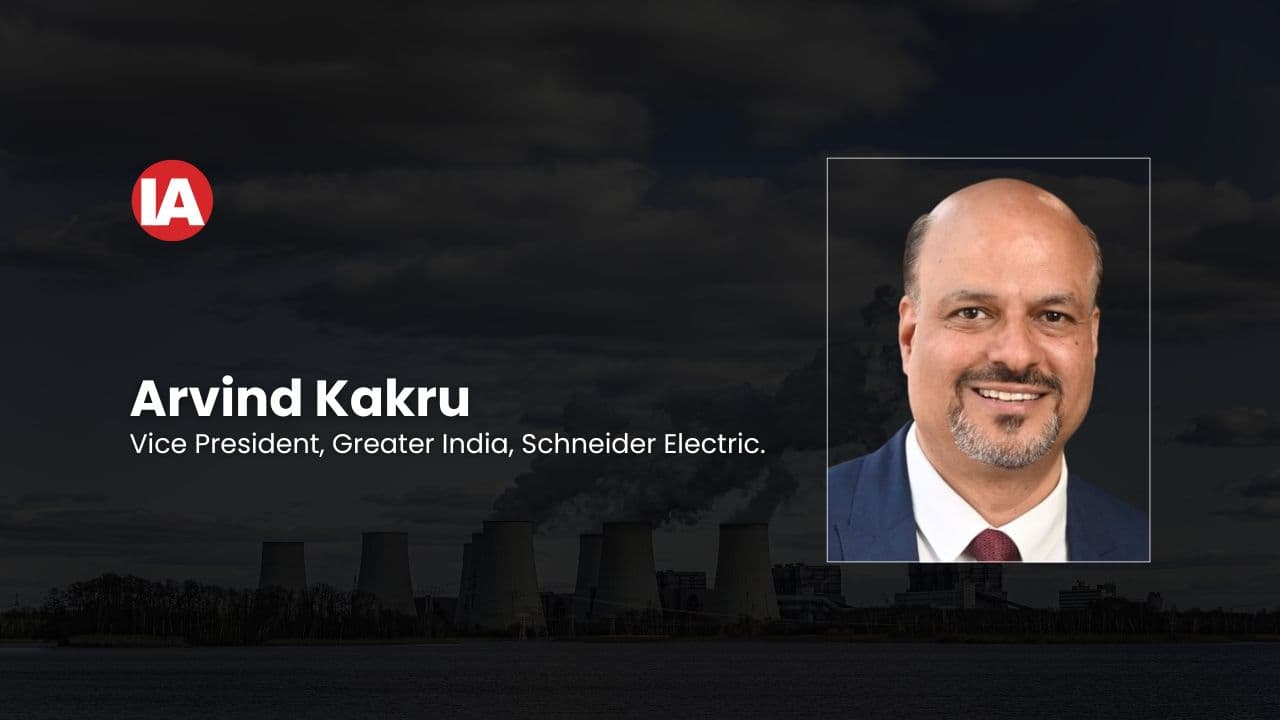
Arvind Kakru, Vice President, Greater India, Schneider Electric.
What are the main sources of industrial emissions that remain difficult to control, despite existing regulations and technologies?
Many industries still face emission sources that are difficult to control, even with advances in regulations and technology. These challenges often come from high-temperature processes, ageing equipment, and operations that continue to rely on fossil fuels. Because these systems have been in place for years and are central to production, replacing or upgrading them isn’t straightforward; it requires time, investment, and smart planning.
As the global energy technology partner for industries worldwide, we understand this complexity. We believe the solution isn’t only about swapping old systems for new ones but about making the entire industrial environment more connected, intelligent, and efficient. Our EcoStruxure™ platform and open automation architecture are designed exactly for that purpose.
By combining energy management, automation, IoT-enabled monitoring, and data analytics, we give organisations real-time visibility into how they use energy and where emissions are created. This helps them identify hidden inefficiencies, predict issues early, and move from reactive firefighting to proactive decision-making.
Our focus is to make sustainability practical and achievable. By supporting industries to become more digital, more electric, and more efficient, we transform hard-to-abate emissions into an opportunity for long-term resilience, competitiveness, and sustainable growth.
How have tightening environmental regulations and global net-zero commitments influenced industry priorities around emission reduction?
Across sectors, industries are recognising that sustainability and profitability go hand in hand. The focus is now on building efficient, digital, and low-carbon operations that can adapt to evolving policies while strengthening long-term resilience. This transition is also being driven by customers and investors who increasingly value transparency and environmental responsibility.
This transformation is also being fuelled by growing expectations from customers, investors, and communities, who demand transparency, accountability, and tangible climate action. Companies are now investing in technologies that not only help them meet emission standards but also enhance efficiency, competitiveness, and long-term value creation.
We are helping our partners accelerate this journey by combining energy management, automation, and digital technologies to make sustainability measurable and actionable. The result is a more efficient and future-ready industrial ecosystem that not only meets regulatory expectations but also contributes meaningfully to global net-zero goals.
Which emerging technologies hold the greatest promise for reducing industrial emissions — such as carbon capture, process electrification, or advanced monitoring systems?
Among the most promising technologies driving industrial decarbonisation, process electrification remains one of the most powerful levers. By shifting operations such as heating, compression, and mechanical drives from fossil fuels to electricity, especially when powered by renewables; we can unlock major efficiency and emission reduction opportunities. In energy-intensive sectors like chemicals, up to 30-70% of total energy use can be electrified, offering a strong foundation for sustainable transformation.
Our Smart Factory in Hyderabad is a living example of this transformation. It leverages Schneider Electric’s EcoStruxure™ platform to integrate automation, real-time energy monitoring, and predictive analytics across all operations. The facility has achieved nearly 15% energy savings and significant CO₂ reduction by using connected technologies that optimise lighting, HVAC, and production processes. It also demonstrates how digital twins and IoT-based systems can create self-learning, adaptive environments that continuously drive efficiency and sustainability.
A key accelerator of this progress is the shift toward open automation, which moves industries away from rigid, proprietary systems toward a more flexible, interoperable, software-driven approach. This allows manufacturers to integrate new technologies faster, unlock data across the entire value chain, and modernise operations without being held back by closed architectures. By making automation vendor-agnostic, modular, and future-ready, open automation becomes a critical enabler of faster decarbonisation and innovation.
These technologies provide real-time visibility across operations, helping detect inefficiencies, predict maintenance needs, and optimise asset performance. By making emissions and energy use visible and measurable, they empower industries to take proactive, data-driven actions.We believe that the convergence of digitalisation and electrification is the most effective route to deep decarbonisation. By combining these technologies, we can help industries build smarter, cleaner, and more resilient operations; driving meaningful progress toward a low-carbon and energy-efficient future.
How effective are digital tools like IoT-based monitoring, AI analytics, or digital twins in identifying emission hotspots and optimising energy use?
Digital tools such as IoT-based monitoring, AI analytics, and digital twins are transforming how industries understand and manage their energy and emission performance. IoT-enabled systems provide real-time visibility into equipment health and process efficiency, allowing teams to monitor consumption patterns, detect inefficiencies, and take timely corrective action before losses or downtime occur. This continuous flow of data creates the foundation for smarter, more sustainable operations.
When we combine this with AI-driven analytics, the insights become even more powerful. AI enables industries to predict energy demand patterns, identify hidden inefficiencies, and optimise performance across assets and processes. This shift from reactive monitoring to predictive intelligence helps reduce energy wastage, enhance productivity, and directly support decarbonisation goals.
Digital twins take this capability a step further by creating a dynamic, virtual replica of the physical plant. This allows teams to simulate operational changes, assess outcomes, and fine-tune systems – without interrupting production. The result is data-backed decision-making that continuously drives efficiency and emission reduction.
Through our EcoStruxure™ platform, we integrate these digital technologies to help industries move from reactive management to proactive, connected, and efficient ecosystems – where sustainability, reliability, and profitability evolve together.
What role do renewable energy integration and electrification of processes play in emission reduction for hard-to-abate industries?
By integrating renewables directly into industrial power systems, companies can stabilise their energy costs, improve reliability, and significantly reduce their carbon footprint. This integration also enables industries to use on-site generation, microgrids, and smart energy storage, ensuring a cleaner and more dependable energy supply.
Electrifying processes; whether in heating, mobility, or production, creates opportunities to harness digital control and precision. When paired with renewable power, this leads to measurable reductions in emissions without compromising output or quality.
At Schneider Electric, we support this transformation through solutions that bring together digital energy management, automation, and renewable integration under one intelligent platform. This approach allows industries to achieve both environmental and operational excellence, turning sustainability into a driver of performance and growth.
In your view, what are the biggest operational or economic barriers preventing industries from adopting cleaner technologies?
While industrial modernisation often involves significant upfront investment, it also unlocks long-term efficiency, resilience, and sustainability gains. With the right digital and automation foundation, industries can accelerate transformation and realise faster returns. We help customers build strong business cases, enable flexible financing, and deliver measurable outcomes that make modernisation both practical and profitable. Our integrated solutions simplify system complexity; whether upgrading processes, integrating renewables, or deploying carbon capture; ensuring projects move seamlessly from pilot to scale. Combined with continued R&D and supportive policies, this approach drives innovation and speeds the transition to sustainable, future-ready operations.
Capability and data gaps further limit confidence, as many organisations lack continuous monitoring, analytics, and the skills to translate data into operational decisions; making it difficult to prioritise interventions and measure real impact. In addition, supply chain and regulatory uncertainty can delay decision-making, with challenges such as managing Scope 3 emissions and navigating evolving policy frameworks requiring close collaboration across suppliers, customers, and regulators.
We address these barriers by combining financing models, open automation, digital twins, and end-to-end energy management, enabling customers to de-risk projects, accelerate scale-up, and capture measurable sustainability and business benefits.
(The views expressed in interviews are personal, not necessarily of the organisations represented)
Mr Arvind Kakru is a senior industrial automation and energy technology leader with close to three decades of experience across P&L management, commercial strategy, sales leadership, and business operations. He is currently the Vice President – Industrial Automation, Greater India at Schneider Electric, where he drives the automation business strategy, growth priorities, and customer transformation initiatives across the region.
Before joining Schneider Electric, Mr Kakru worked with Rockwell Automation for five years. As Director – Sales, he led the commercial organisation covering End Users, EPCs, OEMs, and key industry verticals. In his earlier role as Country Head – End User & EPC Business, he was responsible for strategy, sales delivery, operating plans, margins, cash performance, and overall business execution.
Earlier, he held multiple leadership roles at GE Power, GE Energy Connections, and GE Intelligent Platforms. This included leading the Automation & Controls business for India and South Asia, serving as Chief Commercial Officer for five GE P&Ls in India, and managing the India P&L for GE Intelligent Platforms. He also served on the Boards of GE Intelligent Platforms and GE Power Conversion during this period.
His career at General Electric, which began in 1996, included diverse roles in regional sales, marketing, and business leadership across India before progressing into broader business management responsibilities.
Mr Kakru holds a Bachelor’s degree in Electrical Engineering from Regional Engineering College (NIT), Durgapur (1990–1994). He is known for building strong teams, leading complex businesses, and steering growth across industrial and energy technology markets.