Edge computing is emerging as a practical and powerful solution for MSMEs for manufacturing growth and smarter decision-making, says Darshana Thakkar.
In today’s rapidly evolving manufacturing environment, MSMEs are under constant pressure to improve productivity, reduce operational costs, enhance quality, and make faster business decisions. While large enterprises have already embraced Industry 4.0 technologies, many MSMEs still struggle with delayed data access, machine downtime, inconsistent production performance, and lack of real-time visibility.
One technology that is emerging as a practical and powerful solution for MSMEs is Edge Computing.
Although the term may sound highly technical, the concept is quite simple and extremely relevant for small and medium manufacturing industries. Edge computing helps businesses process and analyse data directly at the machine or production level instead of depending entirely on distant cloud servers. This leads to faster decision-making, improved operational efficiency, reduced downtime, and better business performance.
For MSMEs aiming to become smarter, leaner, and more competitive, edge computing can become a major growth enabler.
Understanding edge computing in simple terms
Traditionally, manufacturing data from machines, sensors, or production systems is sent to centralised cloud servers for processing and analysis. This process often causes delays due to internet dependency, bandwidth limitations, and data transfer time.
Edge computing changes this approach.
Instead of sending all data to the cloud first, edge computing processes critical information locally – near the machines, production lines, or factory floor itself. Only necessary data is later shared with central systems or cloud platforms.
In simple language, edge computing allows machines and systems to ‘think and respond’ faster at the source itself.
For example:
- A machine sensor detects abnormal vibration.
- The edge device instantly analyses the condition.
- The system alerts operators immediately before a breakdown occurs.
Without edge computing, the data may first travel to a cloud server and then return with instructions, causing valuable time loss.
For MSMEs, where every minute of machine stoppage impacts productivity and profitability, this speed becomes highly valuable.
Why edge computing matters for MSMEs
MSMEs often operate with limited resources, lean manpower, and tight profit margins. Therefore, they need practical technologies that deliver measurable business benefits without massive investment.
Edge computing addresses several common MSME challenges.
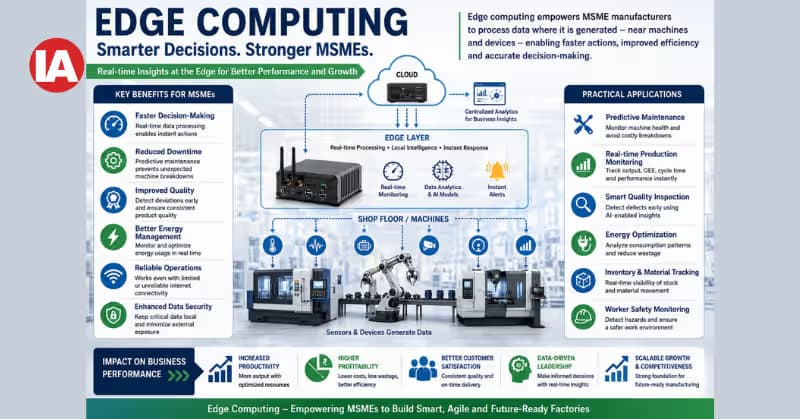
1. Faster and smarter decision-making
Real-time information is becoming essential in manufacturing. Delayed reports often lead to delayed actions.
Edge computing enables immediate access to:
- Machine performance data
- Production efficiency
- Quality deviations
- Energy consumption
- Maintenance alerts, and
- Inventory movement.
This helps production managers and business owners make faster operational decisions.
Instead of reacting after problems occur, MSMEs can move toward predictive and proactive decision-making.
2. Reduced machine downtime
Unplanned machine breakdowns are one of the biggest productivity killers in manufacturing MSMEs.
With edge computing:
- Sensors continuously monitor machine conditions.
- Abnormal behavior is detected instantly.
- Preventive maintenance alerts are generated early.
This reduces unexpected stoppages and improves machine availability.
Even a small reduction in downtime can significantly improve production output and profitability for MSMEs.
3. Improved product quality
Quality issues often arise due to unnoticed variations in:
- Temperature
- Pressure
- Vibration
- Speed, and
- Material handling.
Edge-enabled systems can monitor these parameters continuously and instantly identify deviations.
This allows corrective action before large-scale rejection or rework happens.
As customer expectations and export standards continue to rise, consistent quality control becomes essential for MSME competitiveness.
4. Better energy management
Energy costs are steadily increasing and directly affect manufacturing profitability.
Edge computing helps monitor:
- Power consumption patterns
- Idle machine energy use
- Peak load conditions
- Compressed air leakages, and
- Equipment inefficiencies.
Real-time monitoring enables industries to optimise energy usage and reduce unnecessary wastage.
For energy-intensive MSMEs, this can result in significant annual savings.
5. Lower dependence on continuous internet connectivity
Many MSMEs, especially those located in industrial clusters or semi-urban areas, face internet reliability issues.
Since edge computing processes data locally:
- Critical operations continue even during internet disruptions.
- Production systems remain functional.
- Data loss risk reduces.
This improves operational reliability and business continuity.
6. Enhanced data security
Sending all production data continuously to external servers may increase cybersecurity risks.
Edge computing minimises unnecessary external data transfer and keeps sensitive operational data closer to the factory environment.
This improves data privacy and control, especially important for industries handling proprietary processes or customer-specific manufacturing data.
Practical applications of edge computing in MSMEs
Edge computing is not limited to large automated plants. It can be adopted gradually even in small and medium industries.
Some practical applications include:
- Predictive Maintenance – Monitoring machine health to avoid sudden breakdowns.
- Real-Time Production Monitoring – Tracking production output, cycle time, rejection rates, and machine utilisation instantly.
- Smart Quality Inspection – Using AI-enabled cameras and sensors for defect detection at the production stage.
- Energy Optimisation – Analysing real-time energy consumption patterns.
- Inventory and Material Tracking – Monitoring material movement and stock availability on the shop floor.
- Worker Safety Monitoring – Detecting unsafe conditions, overheating, gas leakage, or hazardous machine conditions.
How edge computing supports overall business performance
Many MSMEs view technology only as an operational tool. However, edge computing impacts overall business performance at a strategic level.
- Increased Productivity – Faster machine response and reduced downtime improve output.
- Higher Profitability – Reduced wastage, energy savings, and improved efficiency directly enhance margins.
- Better Customer Satisfaction – Improved quality consistency and delivery performance strengthen customer trust.
- Data-Driven Leadership – Business owners gain real-time visibility instead of depending only on historical reports.
- Scalability for Future Growth – Edge computing creates a strong foundation for future Industry 4.0 adoption, including AI, IoT, automation, and smart factories.
Challenges MSMEs may face
Despite its advantages, MSMEs may face certain barriers while adopting edge computing:
- Lack of technical awareness
- Limited digital infrastructure
- Investment concerns
- Skilled manpower shortages, and
- Resistance to technology adoption.
However, edge computing solutions are becoming more affordable, modular, and user-friendly.
MSMEs do not need to automate the entire factory at once.
A phased approach works best:
1. Start with one critical machine or process.
2. Implement basic monitoring.
3. Analyse measurable improvements.
4. Expand gradually.
This minimises risk while building confidence and digital maturity.
The role of leadership in technology adoption
Technology transformation is not only about machines and software. It is primarily about leadership mindset.
MSME leaders must recogniae that future competitiveness will depend heavily on:
- Data visibility
- Operational intelligence
- Process efficiency, and
- Speed of decision-making.
Industries that continue relying entirely on manual monitoring and reactive management may struggle in the coming years.
Forward-looking MSMEs are now investing in smart manufacturing not merely for modernisation, but for survival, scalability, and sustainable growth.
Conclusion
Edge computing is no longer a futuristic concept reserved for large corporations. It is becoming a practical and valuable business tool for MSME manufacturers.
By enabling real-time monitoring, faster response, predictive maintenance, improved quality, energy optimisation, and smarter decision-making, edge computing can significantly improve operational and financial performance.
For MSMEs, the real advantage lies not only in technology adoption but in using technology strategically to build agility, efficiency, and competitiveness.
In the era of Industry 4.0, businesses that can make faster and more accurate decisions will lead the market.
Edge computing empowers MSMEs to move from reactive operations to intelligent manufacturing – creating a stronger foundation for growth, resilience, and long-term success.
Darshana Thakkar is an MSME Transformation specialist and Founder of Transformation – The Strategy HUB.
Current Status: Consultant, Author, Speaker, TV panelist, Mentor, Jury member, Columnist in newspaper and Certified Women Director & Independent Director by IICA, MCA, GoI.
Writes weekly column “Business Strategy” in an esteemed Gujarati Newspaper Loksatta-Jansatta.
Darshana Thakkar is a pioneer in transforming MSMEs across India with 29 years of industrial expertise along with herElectrical Engineering and MBA in business operations background.
Darshana Thakkar is a renowned MSME transformation specialist, business growth expert, and advocate for women's entrepreneurship. She has impacted 40,000+ entrepreneurs, including 7,000+ women entrepreneurs, through her mentorship, training programs, and consulting expertise. Her insights and achievements have been featured in leading publications such as Economic Times, Times of India, Sandesh, Hindustan Times, Divya Bhaskar, and a few others.
She had been invited as a Chief Guest/Keynote speaker/panelist for several MSME conclave, Conference, summit organised by leading media house like Economics Times, Hindustan Times, Vibrant Gujarat Regional summit and many other
She is a national leader in MSME growth and innovation and is recognised with prestigious awards like Outstanding Woman Achiever Award-2025 (MSME Transformation Specialist), the Global Women Leadership Award 2024, MSME Honors – Champion of Cause 2023, The Rise Legend-2023 and Gujarat Women Leadership Award-2022.
She has served as a jury member for over 15 national and international award programs recognising MSMEs, startups, and women entrepreneurs. Additionally, she has been covered in prominent business magazines such as World Trade Centre, Industrial Automation, Insight Success, CIO Look India, Corporate Citizen, and CIO World.
She serves as:
• National President, Entrepreneurship Development Council, WICCI
• Mentor, Women Entrepreneurship Platform (WEP), Niti Aayog
• Chairperson, MSME Support & PRO, Makarpura GIDC Association
• Advisory Roles with MSME Business Forum India and Tata Nexarc.
• Member of the Board of Management at Makarpura GIDC Industrial Cooperative Bank Ltd. Vadodara.
https://www.linkedin.com/in/darshanamthakkar/
Mobile: 9106708639
Author