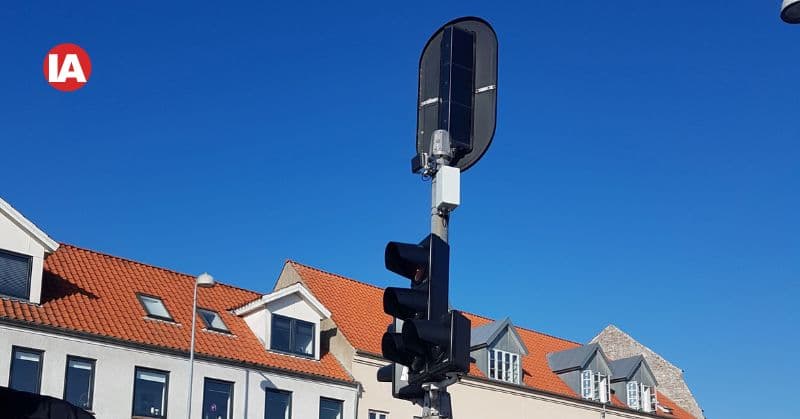
ITS Teknik needed a way to transmit data from the radar to the control cabinet.
ITS Teknik, a specialist in traffic solutions, has adopted the Anybus Wireless Bridge to improve traffic flow management. The technology enables efficient wireless communication between traffic systems, minimising disruptions and ensuring smoother operations. This integration supports ITS Teknik in maintaining traffic efficiency and reliability.

ITS Teknik
ITS Teknik is a market-leading Danish company specialising in traffic safety, planning, and registration solutions that enhance road safety and efficiency. By collaborating with top global traffic equipment suppliers, ITS Teknik offers a comprehensive product portfolio that includes traffic signals, advanced intelligent transportation systems (ITS), signal systems, bicycle barometers, green wave technology for cyclists, weigh-in-motion sensors, parking guidance systems, speed indicators, automated traffic controls, nuber plate scanners, lane signals, and dynamic message signs.
Traffic signaling systems
A key area for ITS Teknik is traffic signaling systems, where their most advanced range uses radar from the German manufacturer smartmicro. These 24 GHz radars detect the position and speed of every road user within their coverage area. They can track up to 256 objects across multiple lanes. This data supports real-time traffic management, helping optimise signal control and improve safety.
The Challenge: Connecting radars
While smartmicro provides the radar, it does not include a built-in communication solution, so ITS Teknik needed a way to transmit data from the radar to the control cabinet. Lars Jakobsen, ITS Teknik Vice Director, explains: “The standard method is to send communication over a cable, but for existing intersections, installing new cables isn’t easy. In some places, we’re not allowed to dig, and even when it’s permitted, we have to close the road or at least one lane, which obviously disrupts traffic. Plus, digging is costly—it requires hiring subcontractors, and you’re never sure what you’ll find underground, so it’s hard to provide accurate estimates to our customers.”

is connected to the radar (2.) via a single serial cable
and paired with another Anybus Wireless Bridge II
in the control cabinet
The Solution: Anybus Wireless Bridge II Serial
Wireless technology provides an effective solution to these challenges. “Wireless is a very attractive option because we can use the existing poles to install the radar and then connect it wirelessly to the control cabinet. It’s quicker, cheaper, and far less disruptive,” explains Lars.
To find a wireless solution, ITS Teknik partnered with HMS Networks, who recommended the Anybus Wireless Bridge II, designed for establishing reliable point-to-point wireless connections. Industrial sensors often rely on serial communication due to its simplicity and reliability. In this case, the radar sensor uses RS-422, a serial interface fully supported by the Anybus Wireless Bridge II.
How it works
The Anybus Wireless Bridge II is connected to the radar via a single serial cable, supplying both power and transmitting data. A second bridge is installed within the control cabinet and connected to ITS's interface card. The two bridges are paired over Bluetooth, enabling wireless communication between the radar and the control cabinet.
Reliable connections are critical for accurate traffic actuation. Lars explains, “You need to predict a vehicle's position, speed, proximity to the stop line, and the exact moment to change the signal from green to yellow to red. It’s about timing the signal change to the split second.”
The project has proven successful, with Anybus Wireless Bridges installed in 300 intersections, totaling 1,600 units supporting 800 radars.
Solving problems together
Using wireless technology to keep traffic flowing safely and efficiently is a new application, and like many new applications, it has had some initial challenges. “When a large vehicle, like a truck, passes, it can disrupt the wireless connection. For the communication to work properly, we can’t have too many gaps in the data flow. But we’ve worked closely with HMS engineers, and together we’ve reduced these disruptions to an acceptable level.”

control cabinet via a serial cable
Future plans
ITS Teknik first started working with Anybus Wireless products in 2015, beginning with the Anybus Wireless Bridge I before moving on to the Anybus Wireless Bridge II. The partnership is working well, and together they’re tackling the next challenge.
“A lot of the control cabinets still use dial-up internet—a technology that’s being phased out. But this technology is being phased out faster than the upgrade of the controllers, leading to communication issues with these older control cabinets.”
To address this, ITS Teknik and HMS Networks are looking into using an HMS Netbiter to remotely access the traffic system. “The Netbiter could allow us to program the traffic system remotely over 4G. Without this capability, when dial-up internet fails, we won’t have a way to monitor the traffic system, forcing us to travel to the site for any issues. This is both time-consuming and expensive”.
The next generation of radar sensors will support Ethernet communication instead of serial, so ITS Teknik plans to start testing the Anybus II Bridge Ethernet. The Ethernet Bridges can handle more data and can be combined with Anybus Access Points, opening up possibilities for more comprehensive monitoring.
Learn more at www.hms-networks.com/anybus and www.its-teknik.dk
HMS Networks AB (publ) is a market-leading provider of solutions in industrial information and communication technology (Industrial ICT) and employs over 1200 people. HMS develops and manufactures products under the Anybus®, Ixxat®, Ewon®, and Intesis® brands (Red Lion® Controls is also a part of the HMS Group as of April 2024). Local sales and support are handled by branch offices all over the world, as well as through a worldwide network of distributors and partners. HMS reported sales of SEK 3,025 million in 2023 and is listed on the NASDAQ OMX in Stockholm in the Large Cap segment and Telecommunications sector.
_____________________________________________________________________________________________
For a deeper dive into the dynamic world of Industrial Automation and Robotic Process Automation (RPA), explore our comprehensive collection of articles and news covering cutting-edge technologies, robotics, PLC programming, SCADA systems, and the latest advancements in the Industrial Automation realm. Uncover valuable insights and stay abreast of industry trends by delving into the rest of our articles on Industrial Automation and RPA at www.industrialautomationindia.in