Lights-out manufacturing is not just about productivity – it also supports sustainability.
When the idea of ‘lights-out manufacturing’ was still largely theoretical, FANUC Corporation quietly turned it into reality. Located at the foothills of Mount Fuji in Japan, FANUC’s factories are widely regarded as the first truly comprehensive lights-out manufacturing facilities in the world, operating for extended periods without human presence and redefining what industrial automation can achieve.
A Factory Designed for Autonomous Operation
FANUC began its journey toward lights-out manufacturing in the late 1970s and early 1980s, long before Industry 4.0 became a buzzword. The motivation was simple but ambitious: build factories that could operate continuously, predictably, and with near-zero defects. Today, several FANUC production lines can run with full autonomous operation for weeks, including weekends and holidays.
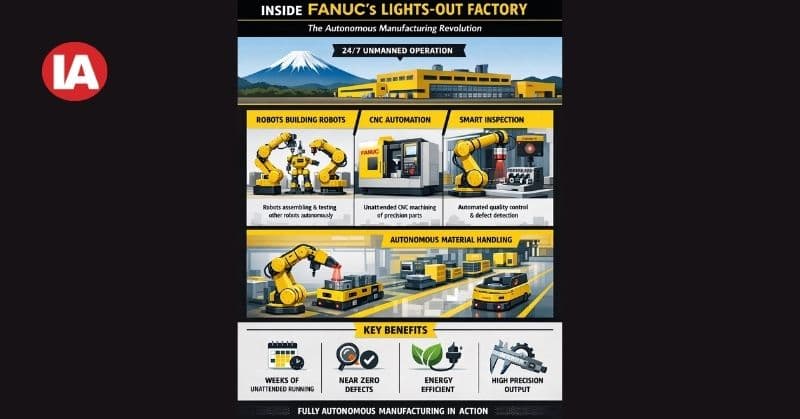
Unlike partial automation seen elsewhere, FANUC’s approach is holistic. Robots build robots, CNC machines produce CNC components, and automated guided systems move parts across the factory floor. Lighting, heating, and even walkways for humans are largely unnecessary—hence the term ‘lights-out’.
Robots Making Robots: The Ultimate Self-Referential Model
One of the most striking aspects of FANUC’s facility is that industrial robots assemble other industrial robots. Robotic arms handle machining, assembly, inspection, and packaging tasks with extreme precision. Human workers intervene mainly for system design, programming, preventive maintenance, and high-level supervision—not for routine production.
This self-referential manufacturing model ensures unmatched consistency. A robot never tires, loses focus, or varies its performance, which allows FANUC to maintain exceptionally tight tolerances across high-volume production runs.
CNC Mastery and Unmanned Machining Stability
FANUC’s lights-out operations are tightly coupled with its CNC expertise. Machine tools equipped with FANUC CNCs run continuously, monitored by sensors and adaptive control systems that detect tool wear, thermal drift, or process anomalies in real time. If deviations occur, machines can automatically compensate or stop the process safely.
This level of process stability enables overnight and multi-day unmanned machining, even for complex precision components—something that remains aspirational for most manufacturers globally.
Quality and Productivity Built into the System
Quality control at FANUC is not an end-of-line activity but an embedded process. Automated inspection systems, in-process measurement, and feedback loops ensure that defects are detected immediately. This dramatically reduces scrap and rework while maintaining traceability across every component produced.
As a result, FANUC achieves productivity levels and defect rates that are nearly impossible to replicate in conventional human-centric factories.
Energy Efficiency and Industrial Sustainability
Ironically, lights-out manufacturing is not just about output—it also supports sustainability. With no need for lighting, climate control for people, or excess infrastructure, FANUC’s factories consume less energy per unit produced. Continuous operation also allows machines to run at optimal efficiency, reducing start-stop losses and mechanical wear.
A Living Proof of the Future Factory
Perhaps the greatest significance of FANUC’s lights-out factory is not technological but philosophical. It proves that fully autonomous, large-scale manufacturing is not a future concept—it already exists. For manufacturers worldwide exploring digital transformation, smart factories, and AI-driven automation, FANUC’s facility serves as a real-world benchmark.
As industries grapple with labour shortages, cost pressures, and quality demands, FANUC’s decades-old experiment stands as a powerful reminder: the factory of the future has been quietly operating for years—without the lights on.
FAQ
1. What is lights-out manufacturing?
Lights-out manufacturing refers to a production methodology where factories are fully automated and run without human presence, often operating in the dark to save energy and costs.
2. How does FANUC achieve near-zero defects?
FANUC achieves near-zero defects through a combination of robots building robots, in-process measurement sensors, and feedback loops that detect and correct anomalies in real-time.
3. What is the role of CNC machines in FANUC's factory?
CNC machines at FANUC produce high-precision CNC components autonomously. They utilize adaptive control systems to monitor tool wear and maintain process stability during unmanned machining.
4. Does FANUC really operate without humans?
While production is autonomous, humans are essential for preventive maintenance, high-level system programming, and strategic supervision of the robotic fleet.
5. How long can FANUC's factory run unattended?
FANUC's production lines are capable of running unattended for up to 30 days at a time, allowing for continuous production through weekends and holidays.
6. Why is lights-out manufacturing considered sustainable?
It improves sustainability by eliminating the need for lighting, heating, and cooling for human workers, thereby significantly reducing the facility's carbon footprint and energy consumption.