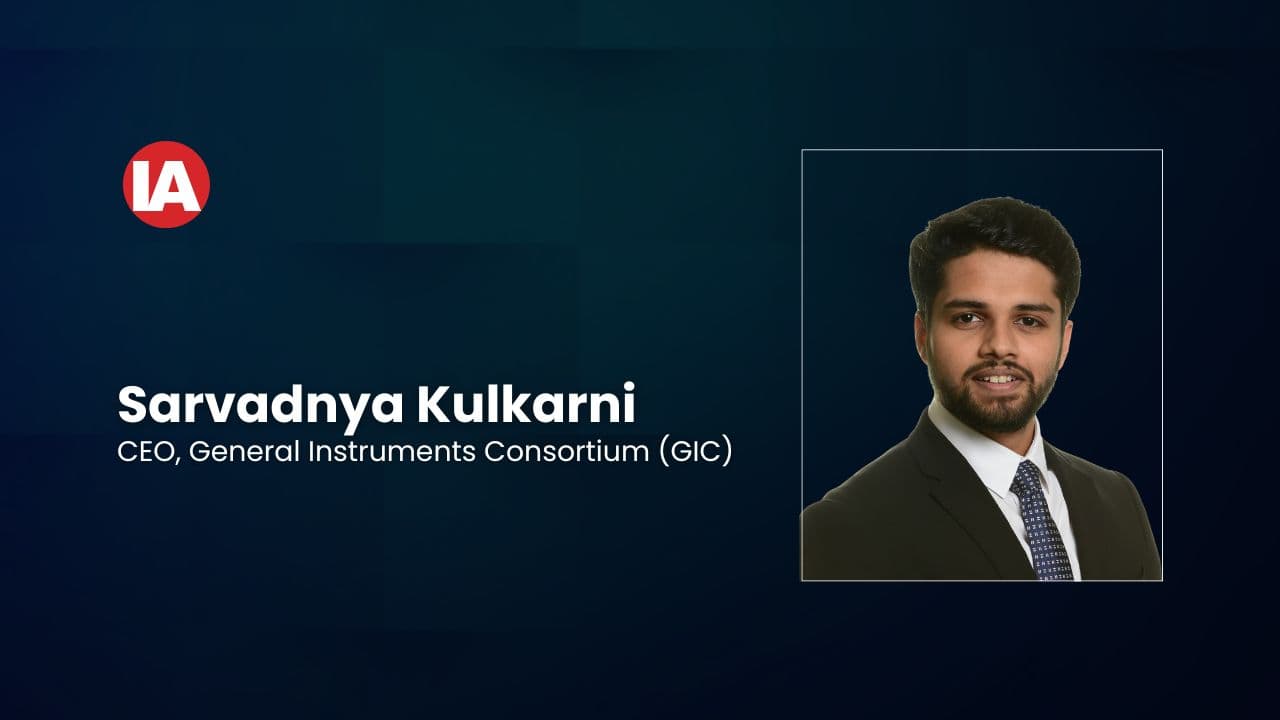
Sarvadnya Kulkarni, CEO, General Instruments Consortium (GIC).

General Instruments began as a small workshop – what were the turning points that transformed it into India’s leading field instrumentation company with exports to 40+ countries?
Capt MM Kulkarni, an electronics engineer from London University after serving in 2 wars, viz., Indo-Pak and Indo-China from 1962-1965 started General Instruments in 1966 as a modest workshop manufacturing pressure and temperature gauges. The first turning point came in the 1970s when we invested in in-house manufacturing of precision components, ensuring quality control at every stage. The second was in the 1990s, when India’s economy opened up, and Amarendra Kulkarni, his son and 2nd generation of GIC seized the opportunity to expand exports, initially to the Middle East and Southeast Asia. More recently, automation, ERP-driven processes, and global certifications such as ISO, CE, ATEX, and SIL allowed us to compete head-to-head with international players. These milestones transformed us into a trusted supplier to over 3000 clients worldwide.
As a third-generation family-run enterprise, how have you balanced legacy values with the need for innovation and global competitiveness?
We have always held on to three legacy values – trust, quality, and customer-centricity. At the same time, we have consciously brought in new practices: design innovation, automation, digitisation, and global partnerships. The balancing act comes from treating legacy values as our foundation while viewing innovation as the bridge to the future. This way, the third generation has been able to modernise operations while staying rooted in what made us successful.
What were the biggest challenges in your domestic-to-global journey, and which new geographies are you targeting next?
Our biggest challenges were around global credibility convincing large oil & gas majors that an Indian company could meet their stringent quality, delivery, and compliance requirements. Building that trust required years of consistency and patience. Logistics and regulatory hurdles were also steep, especially in entering highly regulated regions like Europe and the Middle East. Today, we are focusing on Saudi Arabia, Africa, and North America as our next big growth markets.

Your expansion into Saudi Arabia aligns with vendor localisation mandates like Saudi Aramco’s. How significant is this step for your international growth?
Setting up a manufacturing base in Saudi Arabia is perhaps our most strategic global step yet. Saudi Aramco’s localisation program makes it essential for suppliers to have an on-ground presence. By investing in a KSA facility, we are not only strengthening ties with Aramco but also positioning ourselves as a local partner for the wider GCC region. This will be a game-changer in achieving our ambition of doubling exports in the next five years.
A 70,000 sq.ft green manufacturing plant is coming up in Mumbai by August 2025. How will it shape your sustainability and capacity-building goals?
The upcoming plant will be a benchmark in sustainable manufacturing – solar power, rainwater harvesting, energy-efficient machinery, and zero-liquid discharge systems will all be integral. Beyond sustainability, the additional capacity will allow us to scale production by nearly 50%, meeting rising demand both domestically and internationally. The plant will also house advanced R&D facilities, supporting our journey toward next-generation instrumentation solutions.
Under the third generation’s leadership, turnover has doubled in just three years, crossing USD 30 million. What drove this momentum, and what’s the next growth milestone?
This momentum has been driven by three factors: stronger customer partnerships, diversification of our product portfolio, and aggressive international expansion. We worked on improving delivery timelines, investing in talent, and adopting lean practices to cut waste. Our next milestone is to achieve a turnover of USD 60 million by 2030, with exports contributing at least half of this.
You’ve partnered with 30+ engineering colleges to build a talent pipeline. How is this initiative preparing your workforce for future-ready innovation?
We view academia as a strategic partner in talent building. Our collaboration with engineering colleges includes internships, lab setups under CSR initiatives, and curriculum support. This ensures that students are industry-ready when they join us. At the same time, it gives us a pipeline of young engineers who are skilled in areas like automation, IoT, and data analytics, skills critical for future-ready manufacturing.

Quality-led growth has been a hallmark for six decades. How do you sustain consistency across changing markets and technologies?
Consistency comes from institutionalising quality, not just inspecting it. We have adopted global best practices like Six Sigma, lean manufacturing, and digital inspection systems. Our supply chain is audited rigorously, and every product undergoes 100% testing before dispatch. This culture of “do it right the first time” has allowed us to maintain quality leadership even as we enter new markets and adopt new technologies.
With ambitions to double exports, what role will digital transformation, automation, and sustainability play in the next phase of growth?
Digital transformation will help us streamline operations from ERP-based real-time monitoring to AI-driven predictive maintenance. Automation will reduce human error and increase throughput, particularly in precision machining and testing. Sustainability will ensure that our growth is responsible, carbon neutrality is a long-term goal we are already working toward. Together, these three pillars will allow us to scale globally while meeting customer expectations on cost, quality, and responsibility.
Looking ahead, how do you envision General Instruments’ position in the global field instrumentation industry over the next decade?
A decade from now, we aim to be among the top five independent field instrumentation companies globally. We envision GIC as a brand synonymous with reliability, innovation, and sustainability. Our focus will be on expanding our product range, strengthening our presence in critical energy hubs like the Middle East and North America, and investing in R&D for digital-ready, smart instrumentation. Ultimately, we see ourselves as a global company with Indian roots, helping industries worldwide operate safely, efficiently, and sustainably.