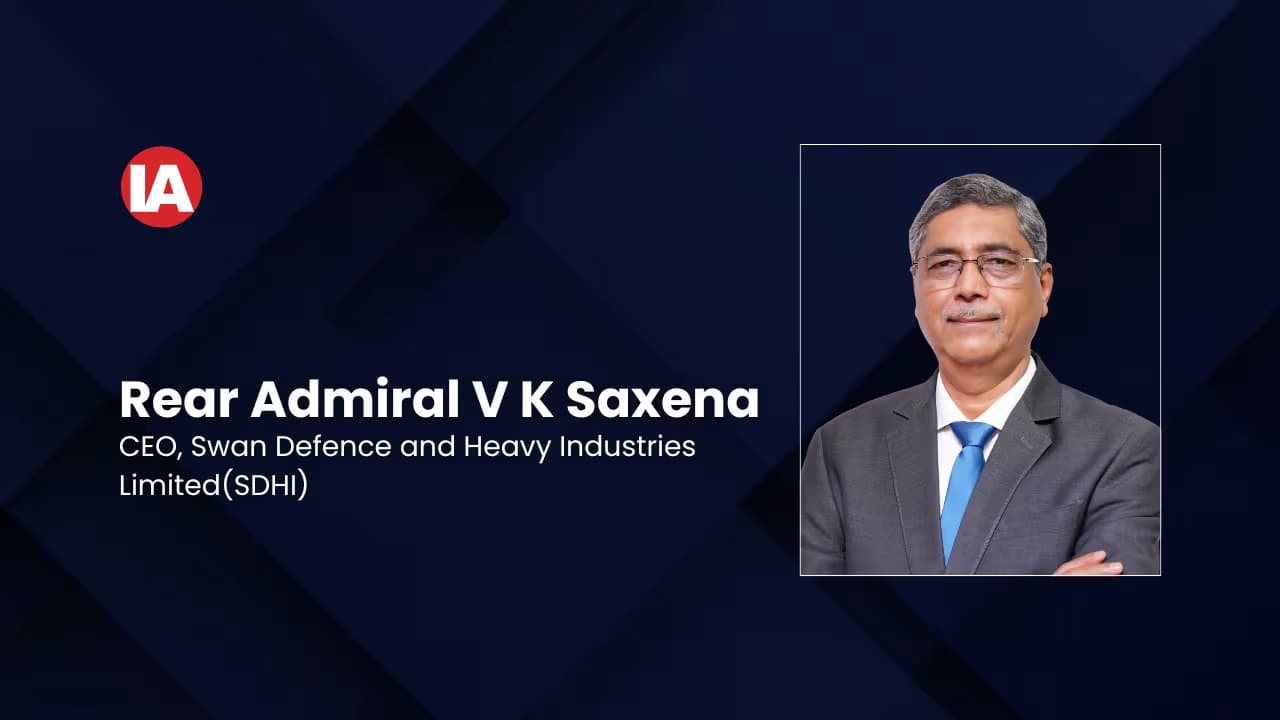
An Exclusive Interview with Rear Admiral V K Saxena, IN (Retd), CEO, Swan Defence and Heavy Industries Limited (SDHI)
In the complex world of heavy engineering, safety is often viewed as a regulatory hurdle. However, at Swan Defence and Heavy Industries Limited (SDHI), it is treated as the bedrock of operational success. Operating one of India’s largest integrated shipbuilding facilities—home to a massive 662m x 65m dry dock—SDHI is redefining what safety looks like in the maritime sector.

operation at india's largest shipyard
Aligning with Global Safety Architecture
Swan Defence and Heavy Industries operates at a scale that demands a robust and internationally recognized safety framework. The organization aligns its policies with:
ISO 45001 Standards: For occupational health and safety management.
IMO Safety Principles: Adhering to International Maritime Organization guidelines.
Statutory Compliance: Meeting requirements from the Directorate General of Shipping, India, and the Directorate of Industrial Safety and Health, Gujarat.
"Beyond compliance, our focus is on embedding safety into the operational culture," says Rear Admiral Saxena. This is achieved through proactive hazard identification and constant site monitoring by independent third-party assessments.
Translating Standards into Shipyard Operations
The real test of any safety policy is its application in high-risk zones like confined spaces, hull blocks, and heavy lifting areas. SDHI implements a permit-to-work system supported by:
Mandatory Gas Testing: Ensuring air quality inside confined hull blocks.
Lockout-Tagout (LOTO): Controlling energy hazards during maintenance.
Engineered Lifting Plans: Executed by certified rigging teams for large steel structural assemblies.
One of the most critical cultural pillars at SDHI is the ‘Stop Work Authority.’ This empowers every employee, regardless of their rank, to halt any activity they deem unsafe.

safety preparedness during shipyard operations
Proactive Risk Assessment: JSA and HIRA
To shift from reactive to anticipatory risk management, SDHI utilizes detailed Job Safety Analysis (JSA) and Hazard Identification and Risk Assessment (HIRA). These exercises are conducted before any major operation, such as a heavy lift or dockside maneuver, begins.
During execution, safety marshals provide continuous supervision, while near-miss reporting is used to fuel root-cause analyses. This loop ensures that "lessons learned" are immediately converted into preventive actions across the facility.
The Role of Automation and Advanced Technology
In an industry defined by high-energy fabrication and repetitive welding, automation is a major safety enabler. SDHI is expanding its use of:
Robotics & Semi-Automatic Welding: Reducing human exposure to heat, toxic fumes, and ergonomic strain.
Digital Twins: Simulating complex build sequences to identify potential hazards before they manifest on the floor.
IoT-Enabled Monitoring: Enhancing real-time visibility across the production floor and hazardous zones.
"Right First Time, Safely"
Shipbuilding is a deadline-driven industry, but SDHI follows the ALARP (As Low As Reasonably Practicable) principle. Safety KPIs are tracked alongside production milestones, ensuring that the pressure to meet a deadline never compromises the safety of the workforce.
As India aims to become a top global shipbuilding nation, SDHI believes that competitiveness will be won through higher safety benchmarks and deeper digital integration. "Safety is not merely a good industrial practice," concludes Rear Admiral Saxena, "it is a strategic enabler of long-term growth."
FAQ.
What safety standards does SDHI follow?
SDHI aligns with ISO 45001, International Maritime Organization (IMO) safety principles, and guidelines from the Directorate General of Shipping, India.
What is 'Stop Work Authority' in a shipyard?
It is a safety policy that empowers any employee at Swan Defence and Heavy Industries to stop an activity immediately if they perceive an unsafe condition, without fear of reprisal.
How does SDHI manage risk during heavy lifts?
Risk is managed through Job Safety Analysis (JSA), Hazard Identification and Risk Assessment (HIRA), and engineered lifting plans validated by certified rigging teams.
How does automation improve safety in shipbuilding?
Automation, such as robotic welding and IoT monitoring, reduces human exposure to hazardous zones, fumes, and high-heat environments while increasing operational precision.