The latest IFR report indicates that cobot adoption is expected to grow by 20-25% in 2026
Dr. Jagannath Raju explains how cobots are enabling safer human-robot collaboration and flexible automation in modern smart factories.
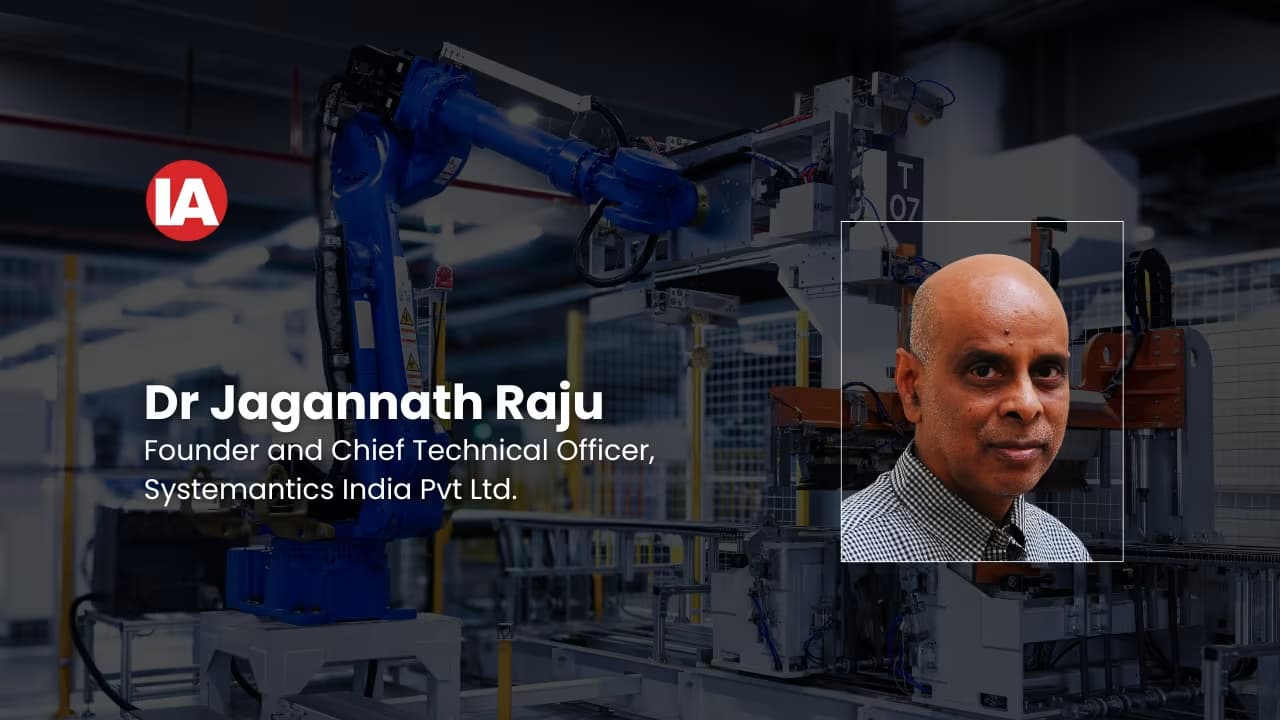
Dr Jagannath Raju, Founder and Chief Technical Officer, Systemantics India Pvt Ltd.
How are cobots redefining human-machine collaboration on the shopfloor, and what tasks are best suited for true ‘co-working’ between people and robots?
Cobots have transitioned the industry from ‘safety by isolation’ to ‘safety by design’. The inbuilt safety features eliminate the need for physical fences, enabling a shared workspace.
However, true collaboration is application-specific; processes like welding or painting still require environmental guarding due to process hazards.
The tasks best suited for HRC (Human-Robot Collaboration) are those that allow humans to manage variability while the robot absorbs the strain of monotonous repeatability. Applications like inspection, material handling, screw-fastening, and assembly, especially in high-mix production facilities, are some of the best use cases.
What design and sensing innovations make cobots inherently safer, and how do these change the way factories think about workplace safety?
Power and Force limiting Technology in cobots makes it inherently safe – the core innovation lies in joint-level motion resistance sensing, which aligns with ISO/TS 15066 standards.
These still provide passive safety – ensuring the cobot stops within milliseconds when it comes in contact with a subject in the environment.
With advancement in sensor technology and Lidar becoming more affordable, cobots can move to active avoidance and speed and separation monitoring, allowing factories to replace rigid fencing with virtual safety zones, making machines contextually aware of their human coworker and in turn lowering the Total Cost of Ownership.
Which repetitive yet skill-intensive operations are seeing the fastest adoption of cobots, and why are they better handled through human–robot collaboration than full automation?
The latest IFR report indicates that cobot adoption is expected to grow by 20-25% in 2026, primarily driven by the need for flexible automation. Skill-intensive operations like welding have started to move to collaborative welding. We are also seeing adoption in electronics (PCB Assembly), Inspection, precision dispensing and Automotive tier-1 component manufacturing processes of machine tending and quality checks through inspections. IFR report (2024) highlights that cobots account for 10% of all industrial robot installations globally, with SMEs showing the most interest.
Production can be increased by allowing humans to contribute to areas of complex decision making and cobots handling the fatigue work. In the case of welding for a high-mix, low-volume manufacturing setup, humans can focus on the weld parameters and quality control rather than ensuring torch angle, distance, speed, etc.
How do cobots balance productivity gains with responsible deployment—ensuring they augment human capability rather than replace it?
By offloading ergonomically hazardous work to cobots, we reduce workplace injuries and improve overall equipment effectiveness through consistent cycle times rather than just raw speed and ensure responsible deployments.
Through our training program during deployment, a single worker, freed from the physical fatigue of loading and unloading, can now oversee multiple work cells and manage complex process variables, upskilling them from ‘operators’ to ‘Robot Managers’.
What new skills must operators and engineers develop to work effectively alongside cobots in a modern manufacturing environment?
Engineers must evolve beyond traditional, ladder-logic PLC programming to embrace ROS2 (Robot Operating System), AI-driven vision integration, and Digital Twin synchronisation – this will enable designing solutions that help in easy re-deployment of cobots across applications, helping create better RoI on the asset.
The no-code intuitive user interface of the cobot reduces the entry barrier for operators to familiarise with the technology, and with training in application-level risk assessment and predictive maintenance logic, they can add value to the work.
As cobots become more intelligent and adaptive, how will their role evolve in creating high-throughput, high-safety production systems?
With advanced vision capabilities and edge AI computing modules being integrated into cobots, the required throughput need not necessarily come from high-speed motion but rather with zero downtime or stoppage.
ASYSTR cobots are already integrated with AMRs as a part of ‘Autonomous Collaborative Manipulation’ – these systems can synchronise to create a resilient ‘dark factory’ capability that maintains the flexibility of human-centric shopfloors.
Multitude of functions and applications would become edge processing based shortly. This would enable Cobots with greater versatility.
5G-enabled networks will facilitate ultra-low latency tele-operation, allowing humans to perform high-dexterity tasks in hazardous environments from a safe distance.
(The views expressed in interviews are personal, not necessarily of the organisations represented)
As Systemantics’s Founder and Chief Technical Officer, Dr Jagannath Raju is responsible for the company’s product development and technology strategy.
His consulting experience in the USA includes the development of innovative robotic systems for space, underwater, and hazardous applications for projects funded by NASA, the Federal Sea Grant Program, the Department of Energy, and the National Science Foundation.
Dr Jagannath Raju is a B Tech from the Indian Institute of Technology, Madras and holds a master’s degree from the University of California, Berkeley, CA, USA and Master’s & Doctoral degrees from Massachusetts Institute of Technology, Cambridge, MA, USA.