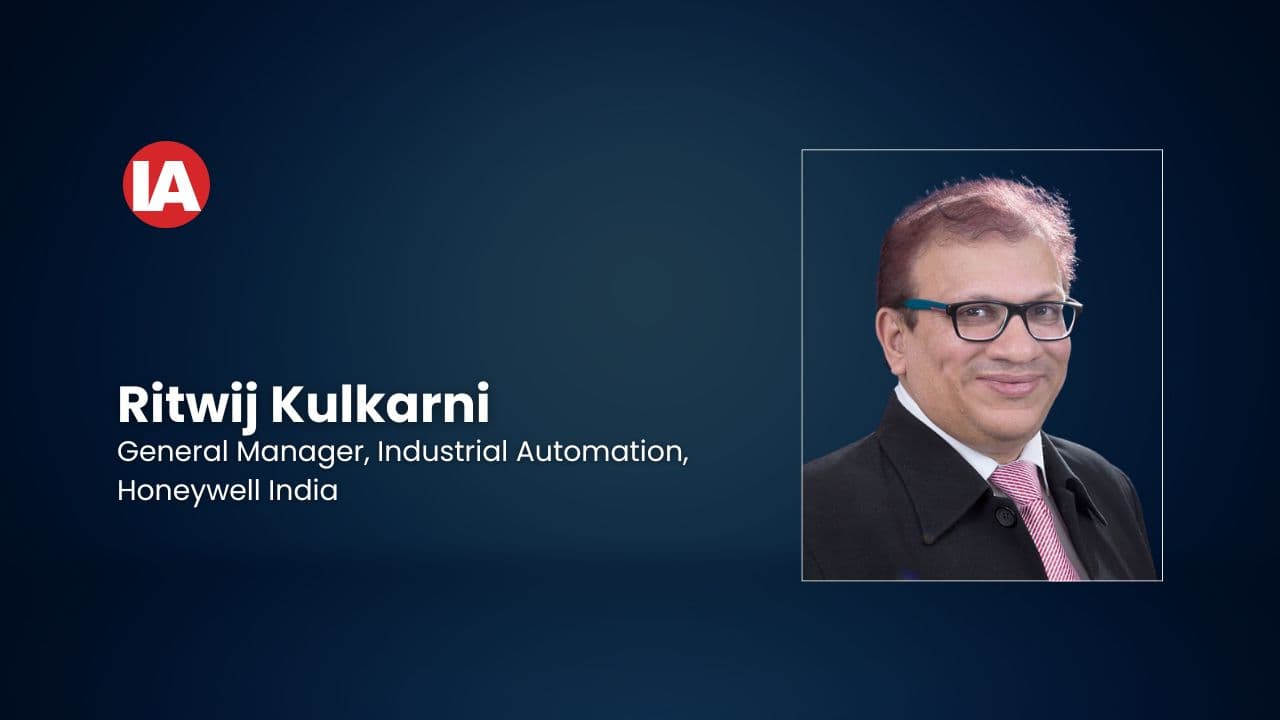
Ritwij Kulkarni, General Manager, Industrial Automation, Honeywell India.
What exactly is Honeywell’s LEAP™ approach and how is it enabling faster, lower-risk, and more cost-effective automation projects in industry?
Honeywell Lean Execution of Automation Projects (LEAP™) is our award-winning methodology that redefines the way automation projects are delivered in complex industrial environments.With LEAP, industries can decouple hardware design from functional designs and significantly reduce engineering hours. This is achieved by enabling parallel execution of tasks, resulting in better optimisation of costs and production schedules.
LEAP is also integrated with cutting-edge innovations such as Universal I/O, virtualisation, cloud-based engineering and automated device commissioning. With these features, our customers can achieve up to 30% savings in automation CAPEX and as much as 25% greater schedule flexibility. Honeywell’s LEAP methodology results in faster delivery, lower project risk and predictable outcomes, ultimately encouraging industries to modernise their environments with ease.
How has LEAP helped Indian customers accelerate their Industry 4.0 transformation journeys?
From MSMEs to large-scale, complex industries, Honeywell has closely supported Indian manufacturers for many decades. In today’s times, Indian industries are modernising faster and more efficiently with new execution models. LEAP supports this transformation with advanced automation solutions. Our predictive and flexible automation solutions enable our customers to integrate digital technologies, such as advanced control, virtualisation, and remote commissioning, without any interruption to execution. Moreover, Honeywell’s LEAP strategy also makes it easier for industries to move away from traditional execution models and adopt next-generation processes that incorporate Industrial Internet of Things (IIoT), AI-based analytics, and connected plant environments.
How do solutions like ControlEdge™ PLC and Experion® real-time control systems contribute to improved operational reliability, scalability, and cyber resilience?
Honeywell’s ControlEdge™ PLC is an advanced programmable logic controller, and Experion® is its real-time process control and automation system. Together, they create a unified automation environment for plants and strengthen their operational continuity, scalability, and cyber resilience.
ControlEdge PLC facilitates easy scaling of operations and provides Digital & Hybrid control in different Industrial segments and applications. Experion on the other hand delivers resilient, fault-tolerant control with real-time visibility of operations. These solutions offer continuous as well batch operations with no downtime. These solutions also have a strong backup of cybersecurity solutions to tackle any security threats and enable industrial plants to operate and expand with less hassle, while remaining secure from evolving threats.
Could you share examples where these technologies have helped overcome the challenges of migrating from legacy systems in India?
Most of the Projects in India are executed using LEAP Philosophy. This was accelerated especially during the COVID period when physical engineering was next to impossible. This provided the ideal platform for scaling up LEAP in most of the projects. Most importantly all Honeywell solutions provide easy migration paths and are backward compatible, thereby protecting initial investments of customers. Many of these migrations can be done online saving time and money.

How do Digital Prime and Honeywell Forge fit into the overall strategy for predictive maintenance, analytics-driven decision-making, and remote asset management?
Honeywell Forge is our cloud-based enterprise platform that drives data-driven performance management. It is complemented by Digital Prime™, our real-time digital twin of the control system. Together, they help industries accelerate innovation, reduce operational risks, and advance predictive maintenance, smarter decision-making, and resilient remote operations through data-driven, real-time insights.
Digital Prime enables customers to simulate changes, train employees, and examine outcomes without affecting live operations. This helps to minimise downtime and speeds up the project delivery. Honeywell Forge utilises AI and advanced analytics to transform operational data into actionable insights, enabling predictive maintenance and performance optimisation. Its secure cloud architecture also strengthens remote asset management by ensuring operators can monitor and manage assets from anywhere with confidence. By working in tandem, the two solutions enable earlier issue detection and support faster, better-informed decisions, resulting in greater reliability, efficiency, and safety across the asset lifecycle.
Can you give a case study where predictive analytics from these platforms prevented downtime or improved efficiency?
There are multiple cases with R&P and O&G Customers wherein we are working to incorporate the benefits of these solutions. This is helping them to increase the efficiency of their operations by predicting the downtime and taking corrective actions in advance.
What strategies does Honeywell recommend for making plant automation architectures flexible and future-ready?
Future-proofing plant automation requires resilience as well as flexibility. Businesses should focus on scalable and modular architecture that is readily capable of embracing new technologies without sacrificing interoperability. Cybersecurity must be a key priority, too; industries must build an inherent layer of security to ensure plants are well integrated, advanced and protected from evolving threats.
At a broader level, adaptive architectures are necessary to build trust around digital transformation in industrial settings. Embracing technological revolution not only supports the transformation of operations but also aids long-term, sustainable economic growth.
How does Honeywell ensure that its solutions remain adaptable to future standards and interoperability needs?
With decades of global engineering expertise and a strong commitment to modernisation, Honeywell creates solutions that scale with evolving standards. This reinforces our commitment to maintaining interoperability across geographies and industries.
Our two major areas of focus are innovation and local investments. At Honeywell, we drive R & D with innovation at the core and strengthen it through local investments. In India, Honeywell continues to build solutions that are tailored to meet local market demands and the evolving needs of diverse industries. Our solutions are not only future-oriented but also practical, scalable and adaptable for industries.
In your view, what role will industrial automation and advanced control systems play in supporting India’s Viksit Bharat 2047 vision?
Industrial automation and advanced control systems will be central to realising India’s Viksit Bharat 2047 vision. Digitalisation will be instrumental in driving greater productivity, improved quality, and predictive operations for India’s industrial landscape. These advances are critical to positioning the country as a global leader in manufacturing and innovation. Automation is also steadily advancing and has become a key catalyst for a smarter, more dynamic, and sustainable industrial economy. Smarter energy management enabled through automation will not only aid businesses to operate profitably but also help them reduce their carbon footprint and support India’s twin goals of economic growth and sustainability.
How is Honeywell collaborating with Indian industry stakeholders to build a robust, secure, and sustainable digital infrastructure?
Honeywell is deeply engaged with Indian industry stakeholders to collaboratively create a digital ecosystem that is both secure and sustainable. By working closely with partners across manufacturing, buildings, and infrastructure, we are contributing to India’s broader vision of digitalisation and sustainability.
Ritwij Kulkarni serves as the General Manager of Industrial Automation vertical at Honeywell India. In his 23-year tenure at Honeywell, Ritwij has been instrumental in driving operational efficiency and automation strategies, providing deep expertise and valuable insights across multiple industries, including oil and gas, chemicals, and manufacturing. His experience has been crucial in enhancing productivity, optimising processes, and advancing Honeywell’s position as a trusted partner in these sectors.
Throughout his career at Honeywell, Ritwij has held various leadership positions, including twelve years with Honeywell Process Solutions. During this period, he has served as the vertical head for refining and petrochemicals, led Distributed Control System (DCS) sales, and managed operations as the regional head for West and Central India, consistently demonstrating strategic expertise across multiple domains. His experience extends to nine years with Honeywell's Automation division, where he served as the business head for lifecycle services and as general manager for Honeywell Building Solutions, showcasing his extensive experience in managing and growing diverse business verticals.
In his current role, Ritwij leverages his extensive knowledge in engineering services, customer operations, and digital transformation to drive Honeywell's growth strategy across the Asia Pacific region. His deep expertise in process automation and dedication to innovation have been fundamental in strengthening Honeywell’s position as a trusted partner for industrial clients, guiding them through digital transformations and efficiency improvements tailored to the region's specific needs.