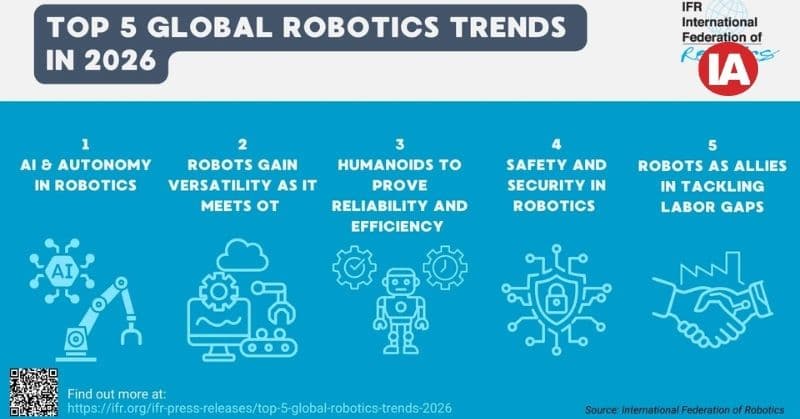
The International Federation of Robotics reports on the top 5 trends for the robotics industry for 2026.
The International Federation of Robotics (IFR) has officially released its comprehensive analysis of the robotics industry, outlining the top five trends set to redefine global production by 2026. As the global market value of industrial robot installations reaches an unprecedented high of US$ 16.7 billion, the sector is moving beyond simple mechanical automation toward a sophisticated ecosystem governed by technological innovations, evolving market forces, and the rise of AI-driven autonomy.
1. AI & Autonomy: The Evolution of Agentic AI
The primary driver of modern robotics growth is the integration of high-level artificial intelligence. We are witnessing a transition where robots no longer just follow scripts but exercise structured decision-making. This shift is powered by a hierarchy of AI systems:
- Analytical AI: This remains the backbone of the smart factory. By processing massive historical datasets, Analytical AI detects subtle patterns to provide actionable insights. In 2026, this is most prevalent in predictive maintenance and logistics, where robots autonomously optimize path planning and resource allocation to prevent bottlenecks before they manifest.
- Generative AI (GenAI): GenAI has fundamentally changed human-robot interaction. By moving away from rigid, rule-based coding, GenAI allows robots to understand natural language and vision-based commands. This enables a self-evolving system where robots can generate their own training data through simulations, significantly reducing the time required to "teach" a robot a new task.
- Agentic AI: The most significant breakthrough for 2026 is Agentic AI. This hybrid technology merges the logic of analytical models with the creative adaptability of generative systems. Agentic AI allows for a level of independent operation previously unseen, enabling robots to navigate complex, real-world environments and make real-time adjustments without human intervention. This trend is the cornerstone of the next generation of autonomous mobile robots (AMRs).
2. The Industrial Synergies of IT/OT Convergence
The robotics industry is currently being reshaped by the accelerated demand for versatility. This trend is a direct result of the IT/OT convergence—the blending of Information Technology (IT) and Operational Technology (OT). Historically, these two departments operated in silos: IT managed the data, while OT managed the physical machinery.
In 2026, the digital enterprise relies on the seamless flow of data between these two worlds. The convergence allows for a "digital twin" environment where physical robot movements are perfectly mirrored and optimized by data-processing power in the cloud. This integration is the bedrock of Industry 4.0, turning a standard production line into a living, breathing network of responsive machines. By breaking down these silos, companies can achieve real-time visibility into every aspect of their operations, from supply chain arrival to final quality inspection.
3. Humanoid Robotics: Moving to Scale in Manufacturing
Once a futuristic concept, humanoid robotics have entered the phase of industrial validation. The automotive industry led the charge, but 2026 sees these robots expanding into general manufacturing and warehousing. The value proposition of a humanoid robot is its ability to operate in environments designed specifically for humans, eliminating the need to redesign entire factories for automation.
However, for humanoids to achieve mass adoption, they must prove their reliability and efficiency against traditional automated systems. Key industrial requirements now focus on:
- Cycle Times: Humanoids must match the speed of specialized machinery to justify their footprint.
- Human-Level Dexterity: Advanced sensors and end-effectors are being developed to mimic the human hand's ability to manipulate delicate or irregular objects.
- Energy Consumption: 2026 models focus on battery longevity and power-efficient actuators to ensure a full shift of operation without frequent charging interruptions.
- Standardization: As humanoids fill critical labour gaps, the industry is moving toward standardized metrics for maintenance costs and consistent performance levels across different vendors.
4. Redefining the Safety Landscape and Liability
As robots move out of safety cages and work alongside humans, the safety landscape has become a primary focus for regulators. The unpredictability of AI-driven systems makes traditional testing and validation methods insufficient. In 2026, the industry is grappling with the "black box" nature of deep learning models, where a robot's decision-making process can be difficult to audit.
This has led to a push for robust liability frameworks. If an autonomous robot makes an error in a collaborative setting, clear governance is required to assign responsibility between the manufacturer, the software developer, and the end-user. Furthermore, the expansion into cloud-connected environments has opened new fronts for cybersecurity. Hacking attempts targeting robot controllers are on the rise, necessitating the adoption of ISO safety standards that specifically address digital-physical security. Protecting sensitive data—including audio and video streams collected by robots—is now as important as physical safety.
5. Robots as Allies in the Global Talent War
The final trend for 2026 addresses the chronic labour gaps affecting sectors from healthcare to heavy manufacturing. With unfilled jobs causing increased stress and fatigue for existing staff, robotics and automation are being rebranded as "workplace allies."
Successful implementation now requires "onboarding" the human workforce alongside the technology. Companies that prioritize skilling and upskilling programs are seeing higher acceptance rates. By delegating routine, repetitive, and dangerous tasks to robots, employees can move into more creative, supervisory, or technical roles. This transition doesn't just solve a numbers problem; it makes the industrial workplace significantly more attractive to younger generations who expect a high-tech, digitally-integrated work environment.
FAQ
Q1: What is the market value of industrial robot installations in 2026?
As of the latest IFR report, the global market value for industrial robot installations has reached an all-time high of US$ 16.7 billion.
Q2: How is Agentic AI different from Generative AI in robotics?
While Generative AI helps robots learn via natural language and simulation, Agentic AI combines that adaptability with analytical AI’s structured decision-making, allowing robots to function independently in complex environments.
Q3: Why is IT/OT convergence important for smart factories?
IT/OT convergence allows the seamless flow of data between digital management systems and physical machinery, which is essential for real-time analytics and the realization of Industry 4.0.
Q4: What industries are currently deploying humanoid robots?
While pioneered by the automotive industry, humanoid robots are now seeing significant deployment in warehousing, manufacturing, and internal logistics.
Q5: What are the primary cybersecurity risks in modern robotics?
Major risks include unauthorized access to robot controllers, hacking of cloud-connected platforms, and the potential exposure of sensitive data like audio, video, and sensor streams.
Q6: Are there specific safety standards for AI-driven robots in 2026?
Yes, robotic systems must be designed and certified in accordance with updated ISO safety standards and emerging liability frameworks to manage the complexities of AI autonomy.